
Supreme Court Unveils Redesigned Lady Justice Statue, Removes Blindfold And Replaces Sword With Constitution
The Supreme Court of India has unveiled a redesigned statue of Lady Justice, removing the traditional blindfold and replacing the sword with a copy of the Constitution of India. The change reflects a renewed emphasis on constitutional values and India's judicial identity.
Published on 16 October 2024 • 12:00 am
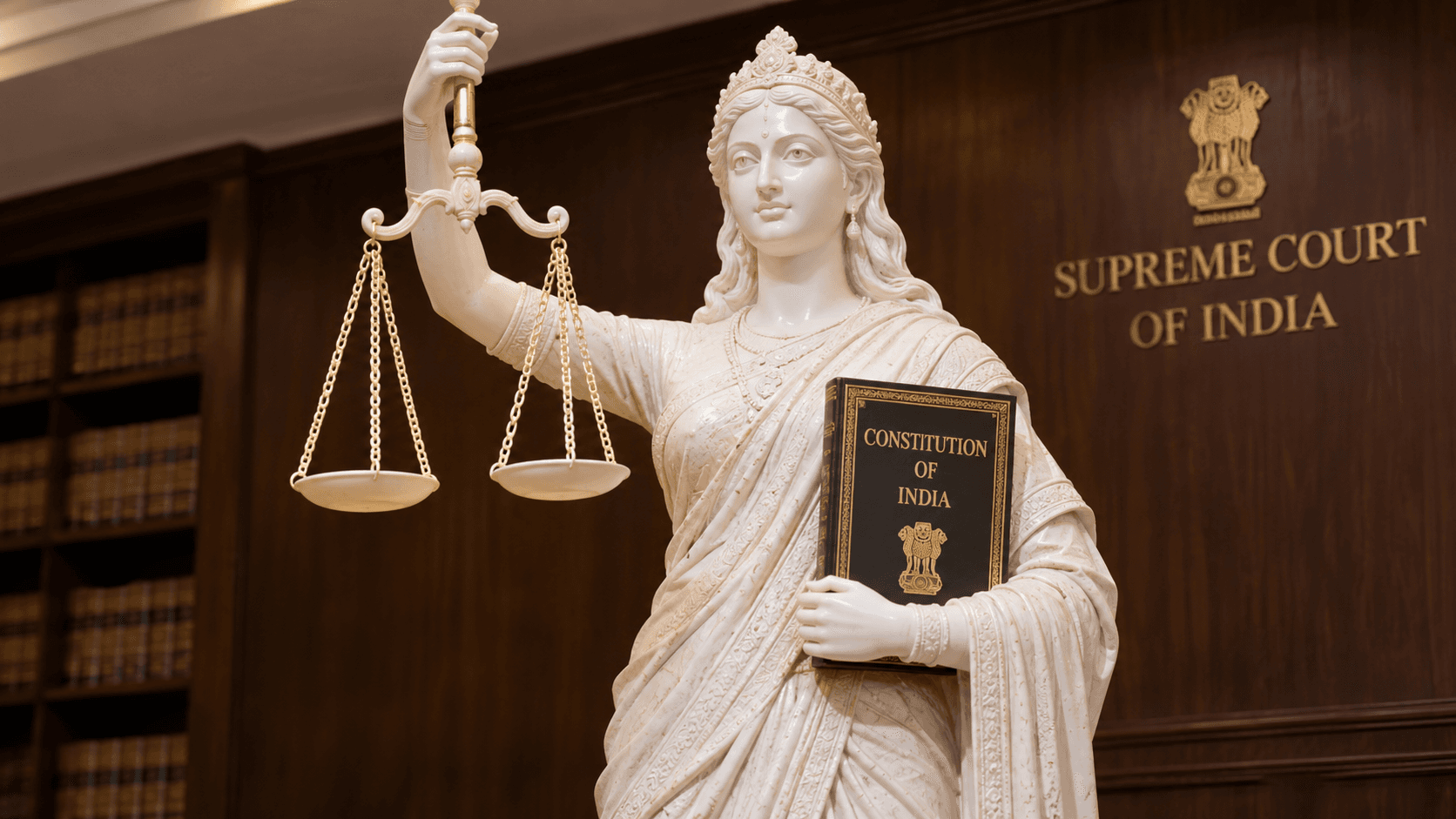
Blindfold Removed: A Message That Law Is Not Blind
The Supreme Court of India has unveiled a redesigned statue of Lady Justice, removing the traditional blindfold and replacing the sword in her hand with a copy of the Constitution of India. The change reflects a renewed emphasis on constitutional values and the idea that justice must be delivered in accordance with the Constitution.
The redesigned statue has been installed in the judges' library of the Supreme Court and was commissioned at the direction of then Chief Justice of India D.Y. Chandrachud.
The six-foot-tall statue depicts Lady Justice wearing a saree, with her eyes open, holding the scales of justice in one hand and the Constitution in the other.
Traditionally, Lady Justice has been depicted wearing a blindfold, holding scales in one hand and a sword in the other.
The blindfold has conventionally symbolised impartiality and equality before the law, conveying that justice must not be influenced by a person's wealth, power, position or social status.
However, the redesigned statue carries a different message. The removal of the blindfold is intended to convey that the law is not blind and must see everyone equally.
According to reports citing sources associated with the Chief Justice's office, Justice Chandrachud believed that the Indian judicial system should move beyond colonial-era symbolism and adopt an identity rooted in India's constitutional framework.
Constitution Replaces Sword
Another significant change is the replacement of the sword with a copy of the Constitution of India.
Traditionally, the sword represented the authority of law and the power to punish wrongdoing. In the redesigned statue, the Constitution takes its place, emphasising that courts administer justice through constitutional principles rather than the symbolism of force or punishment.
The idea behind the change is that the Constitution, as the supreme law of the land, must remain central to the administration of justice.
The scales in Lady Justice's other hand have, however, been retained. They continue to represent balance, fairness and the impartial consideration of evidence and arguments presented by opposing parties.
Moving Beyond Colonial-Era Symbolism
The redesign has also been viewed in the context of the broader effort to move away from colonial-era legal and institutional practices.
India has undertaken significant changes to its criminal law framework, including replacing the Indian Penal Code, 1860, with the Bharatiya Nyaya Sanhita, 2023.
The redesigned statue similarly seeks to present an image of justice associated with India's constitutional identity rather than simply retaining inherited colonial symbols.
The new representation does not abandon the traditional idea of Lady Justice altogether. Instead, it retains the scales while changing the symbolism associated with the blindfold and sword.
A New Symbolism For Indian Justice
With open eyes, the Constitution in place of the sword and the scales retained, the redesigned Lady Justice represents an approach that places constitutional values at the centre of judicial decision-making.
The change is symbolic rather than a modification of the legal standards governing adjudication. Its central message is that justice must be impartial, but it must also remain conscious of constitutional rights, equality and the rule of law.