
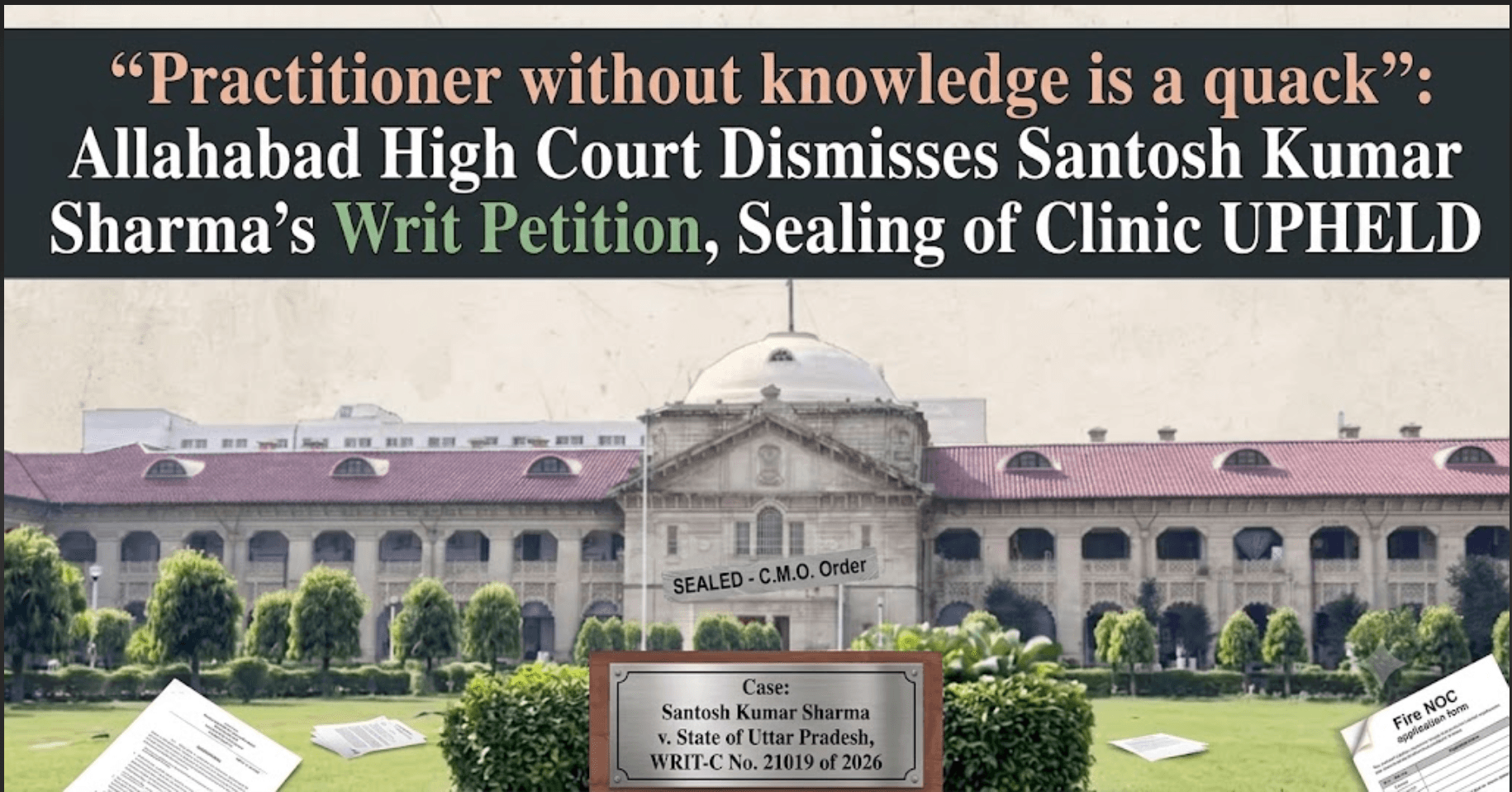
Allahabad High Court Upholds Sealing of Clinic, Says Electro Homeopathy Qualification Does Not Authorise Allopathic Practice
The Allahabad High Court has held that qualifications in electro homeopathy do not authorise the practice of allopathic medicine, observing that practising an unfamiliar medical system amounts to quackery and endangers public health.
Published on 17 July 2026 • 04:30 am
Background
The petitioner challenged the sealing of his clinic after authorities concluded that he was administering allopathic medicines despite possessing only qualifications in electro homeopathy and community health.
Following an inspection, the Chief Medical Officer found multiple statutory violations and initiated both regulatory and criminal proceedings.
Regulatory Violations
Apart from lacking recognised medical qualifications, the clinic was found to be unregistered, lacked biomedical waste management facilities, had no fire safety clearance, failed to maintain infection control standards and permitted unqualified persons to provide treatment.
The Court observed that each of these deficiencies independently justified regulatory action.
Court's Analysis
The Bench reiterated that registration under one system of medicine does not authorise practice under another unless specifically recognised by law. Relying upon Mukhtiar Chand v. State of Punjab, the Court held that only recognised allopathic practitioners may administer modern medicine.
The Court further observed that Article 19(1)(g) permits the State to regulate professions through reasonable restrictions in the interest of public health.
Decision
Finding no illegality in the decision of the Chief Medical Officer, the High Court dismissed the writ petition and upheld the order sealing the clinic.
"A person who practises a system of medicine without possessing the necessary knowledge is a quack and merely pretends to possess medical skill."
— Allahabad High Court
Key Takeaways
Electro Homeopathy ≠ Allopathy
Qualification in one medical system does not authorise practice in another.
Public Health First
Medical regulation exists to protect patients from unqualified treatment.
Clinic Standards Mandatory
Registration, biomedical waste disposal, fire safety and infection control are statutory requirements.
Professional Regulation
Reasonable restrictions under Article 19(1)(g) permit regulation of medical professions.
Legal Significance
The judgment reinforces the Supreme Court's long-standing principle that cross-practice without statutory recognition is impermissible and highlights the constitutional importance of regulating healthcare professions in the interest of public safety.
Case Details
Case
Santosh Kumar Sharma v. State of Uttar Pradesh
Court
Allahabad High Court
Bench
Justice J.J. Munir & Justice Indrajeet Shukla
Decision Date
10 July 2026
Case Number
WRIT-C No. 21019 of 2026
This article summarises the judgment for informational purposes and should not be treated as legal or medical advice.